Intelligent Fabrication: Five AI-Driven Technologies Giving Micro-Factories a Competitive Edge

Photo: JPxG, Public domain, via Wikimedia Commons
The conventional wisdom in American manufacturing has long held that quality at scale requires scale itself — that the investments necessary to achieve consistent, precise, high-complexity production were simply beyond the reach of smaller operations. That assumption is eroding with remarkable speed.
Artificial intelligence, computer vision, and next-generation automation are collectively dismantling the technological barriers that historically disadvantaged micro-scale manufacturers. The result is a production landscape in which a well-equipped micro-factory can deliver levels of precision, customization, and process consistency that rival — and in certain dimensions exceed — what larger, more capital-intensive facilities can offer. For industrial enterprises evaluating distributed production strategies, understanding these technologies is no longer optional. It is operationally essential.
1. Generative Design: Engineering Complexity Without Engineering Overhead
Generative design software — which uses AI algorithms to explore thousands of geometric configurations against a defined set of performance constraints — was initially developed for aerospace and automotive applications where weight reduction and structural optimization are paramount. Its migration into micro-manufacturing contexts is proving transformative for an entirely different reason: it dramatically reduces the engineering labor required to produce complex, custom components.
For a micro-factory serving industrial clients with highly specific requirements, generative design compresses the path from customer specification to manufacturable geometry. Rather than assigning an engineering team to manually iterate on part designs, the software surfaces optimized configurations automatically, often producing geometries that are both lighter and stronger than conventionally designed equivalents. The practical effect is that smaller manufacturing operations can take on sophisticated custom work without the engineering headcount that such work once demanded.
As AI model training sets expand and software interfaces become more accessible, generative design is transitioning from an enterprise-tier tool to one that micro-factory operators can realistically deploy — a shift with significant implications for competitive positioning.
2. Computer Vision Quality Systems: Inspection at Machine Speed
Quality control has historically been one of the most labor-intensive and error-prone functions in precision manufacturing. Human inspectors, regardless of skill level, are subject to fatigue, inconsistency, and throughput limitations that become acute as production volumes and complexity increase.
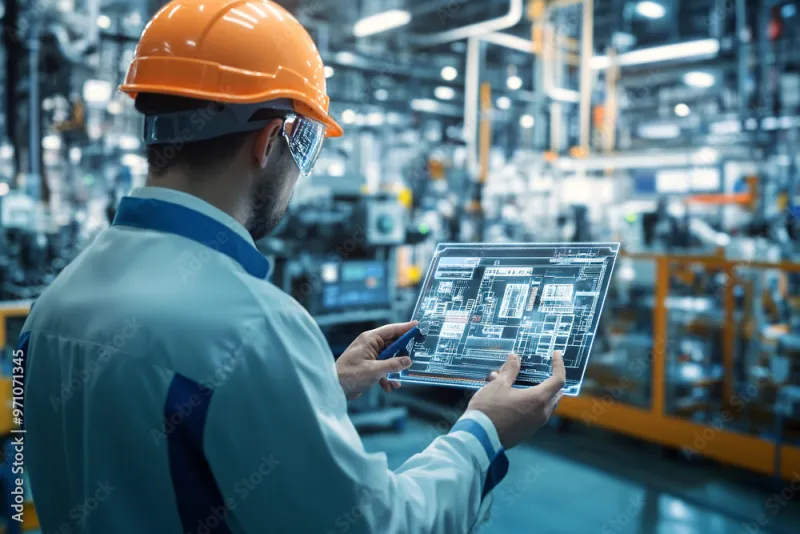
AI-powered computer vision systems are replacing and augmenting manual inspection across a widening range of micro-manufacturing applications. These systems use high-resolution imaging combined with trained neural networks to detect dimensional deviations, surface defects, and assembly errors at speeds and accuracy levels that human inspection cannot approach. Critically, they generate structured data on every inspected part — creating quality records that support traceability requirements in regulated industries including medical devices, aerospace components, and defense-related manufacturing.
For micro-factories, the value proposition is particularly direct. A single computer vision inspection station can maintain the quality throughput of multiple human inspectors while simultaneously producing the documentation infrastructure that enterprise customers increasingly require as a condition of supplier qualification. The capital cost of these systems has declined substantially, and cloud-based training platforms mean that micro-factory operators can configure inspection models for new part families without extensive in-house machine learning expertise.
3. Predictive Maintenance: Eliminating Unplanned Downtime at the Worst Possible Moment
In a centralized manufacturing environment, an unplanned equipment failure is disruptive. In a micro-factory serving a just-in-time supply chain, it can be catastrophic. With fewer machines and less redundant capacity, smaller operations have historically carried disproportionate exposure to downtime risk.
Predictive maintenance platforms — which use IoT sensor arrays, vibration analysis, thermal imaging, and machine learning models to identify equipment degradation before failure occurs — are directly addressing this asymmetry. By continuously monitoring the condition signatures of CNC machines, robotic cells, and other critical assets, these systems allow operators to schedule maintenance interventions during planned windows rather than responding reactively to breakdowns.
The operational impact extends beyond simple downtime reduction. Predictive maintenance data also supports more accurate capacity planning, enables more precise consumable management, and provides the kind of equipment performance documentation that supports both internal continuous improvement efforts and external customer audits. For micro-factory operators competing on reliability as a differentiator, the ability to demonstrate measurably low unplanned downtime rates carries genuine commercial value.
4. Adaptive Tooling and Closed-Loop Process Control: Precision That Adjusts Itself
Traditional manufacturing process control depends on operators — or at best, statistical sampling systems — to detect drift and make corrective adjustments. In high-precision micro-manufacturing, where tolerances are tight and batch sizes are small, the window between acceptable variation and scrap generation can be narrow enough that conventional control methods are insufficient.
Adaptive tooling systems, paired with closed-loop process control algorithms, address this challenge by making real-time adjustments to machining parameters based on continuous in-process measurement. Sensor data from cutting forces, spindle loads, and dimensional feedback is processed by AI models that modify feed rates, cutting depths, and tool paths on the fly — maintaining dimensional accuracy even as tool wear, material variability, and thermal conditions evolve during a production run.
The implications for micro-factory competitiveness are substantial. Operations that can maintain tight tolerances across an entire production run — not just at the beginning when tools are fresh and conditions are nominal — can credibly pursue contracts in precision-sensitive sectors that were previously accessible only to larger, more elaborately equipped facilities.
5. AI-Assisted Production Scheduling: Optimizing the Constraint
In any manufacturing environment, scheduling is the art of allocating constrained resources — machines, tooling, labor, and materials — across competing demands. In a micro-factory, where resource pools are smaller and the margin for scheduling error is correspondingly thinner, this challenge is amplified.
AI-driven scheduling platforms are bringing a new level of analytical rigor to this function. By modeling machine availability, setup time requirements, material lead times, and customer priority simultaneously, these systems generate production schedules that optimize throughput and on-time delivery performance in ways that manual planning and conventional ERP systems cannot match. More importantly, they can re-optimize dynamically when conditions change — accommodating rush orders, equipment issues, or material delays without requiring a planner to manually reconstruct the entire schedule.
For micro-factories competing on responsiveness and lead time, intelligent scheduling is not a back-office efficiency tool. It is a customer-facing capability that directly supports the promise of flexibility and speed that distinguishes distributed micro-manufacturing from its larger, less agile counterparts.
The Compounding Effect of Intelligent Integration
The most significant competitive advantage, however, does not reside in any single one of these technologies. It emerges when they are deployed as an integrated system — when generative design informs toolpath generation, computer vision data feeds back into process control, predictive maintenance data informs scheduling, and AI scheduling optimization accounts for real-time equipment and quality status simultaneously.
Micro-factories that build toward this level of intelligent integration are not merely automating individual tasks. They are constructing a production nervous system — one that perceives, adapts, and improves continuously. In a manufacturing landscape where the ability to deliver precision, customization, and reliability at smaller scale is increasingly the basis of competitive differentiation, that capability represents a durable strategic advantage.