Automation Economics Inverted: The Real Cost Advantage of Small-Footprint Manufacturing
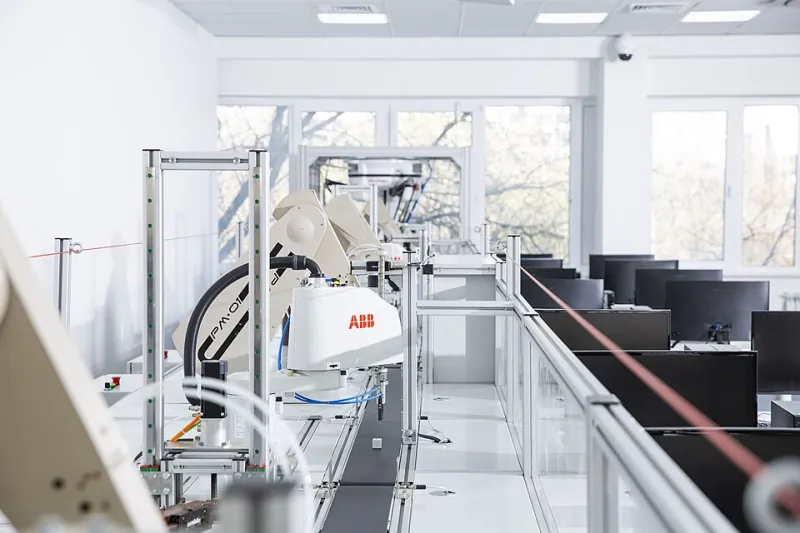
Photo: Нечаева Лилия Александровна, CC BY-SA 4.0, via Wikimedia Commons
For most of the past century, the calculus of industrial automation was straightforward: the larger the facility, the more justifiable the capital expenditure. Robotics, precision tooling, and automated quality systems required enormous throughput to amortize their costs meaningfully. That logic shaped factory design, supply chain architecture, and workforce strategy across virtually every sector of American manufacturing.
It is no longer an accurate picture.
A growing body of operational data from companies that have deployed automation within distributed micro-factory networks reveals a counterintuitive reality: smaller production footprints, when engineered correctly, can generate automation ROI that outpaces what centralized mega-facilities achieve. Understanding why requires moving beyond sticker price comparisons and into a rigorous accounting of total cost of ownership.
The Incomplete Ledger of Traditional Automation Investment
When manufacturers evaluate automation at large centralized plants, they typically focus on the ratio of capital expenditure to units produced. By that narrow measure, scale appears to win decisively. A robotic welding cell that costs $400,000 looks far more efficient when spread across two million annual units than across two hundred thousand.
The problem is that this calculation omits a substantial portion of the true cost structure. Centralized automation carries embedded overhead that rarely appears in project-level ROI models:
- Labor burden beyond the production floor. Large facilities require supervisory layers, shift coordinators, maintenance departments, and quality assurance teams whose headcount scales with facility size regardless of automation level. A micro-factory deploying targeted automation often operates with a workforce that is 60 to 75 percent leaner on a per-unit basis.
- Logistics and inventory carrying costs. Centralized production necessarily creates distance between manufacturing and end markets. The resulting freight expenditure, warehousing requirements, and working capital tied up in transit inventory represent costs that automated efficiency on the production floor cannot offset.
- Downtime exposure. When a critical automated system fails in a centralized facility, the production impact is enterprise-wide. Distributed networks absorb localized failures without systemic disruption, a resilience characteristic that carries measurable financial value when modeled over a five- to ten-year horizon.
Where Micro-Factory Automation Actually Wins
The automation advantage in distributed micro-manufacturing environments emerges from several interconnected dynamics.
First, the technology landscape has shifted dramatically. Collaborative robots — cobots — now enter the market at price points between $25,000 and $75,000 per unit, making deployment economically viable at production scales that would have been irrational targets for automation a decade ago. Vision systems, edge-computing quality inspection platforms, and modular CNC equipment have followed similar trajectories. The capital threshold for meaningful automation has dropped substantially.
Second, micro-factories are inherently purpose-built. Rather than housing a diverse mix of product lines within one sprawling facility, they are typically designed around a specific product family or process type. That focus allows automation investments to be precisely matched to the actual workflow, eliminating the inefficiency of general-purpose equipment carrying excess capability.
Consider the experience of a mid-market aerospace components supplier that restructured its production model around four regional micro-factories in the Southeast and Midwest. Prior to restructuring, the company operated a single 280,000-square-foot facility with a conventional automation ratio. After transitioning to the distributed model, each micro-factory was equipped with targeted cobot cells and automated inspection systems calibrated to the specific tolerances of its product mix. Within 30 months of full deployment, the company reported a 34 percent reduction in per-unit labor cost and a 19 percent improvement in first-pass yield rates — the latter directly attributable to inspection automation that could be tuned precisely because product variability within each facility was narrow.
Quality Standards and the Automation Precision Premium
One concern frequently raised by operations executives evaluating micro-factory automation is whether smaller facilities can sustain the quality standards that justify premium pricing or satisfy demanding contractual requirements. The evidence suggests this concern is misplaced — and in many cases, inverted.
Precision automation deployed in a constrained, well-defined production environment tends to outperform the same technology applied to a high-variability, multi-product facility. The signal-to-noise ratio for automated quality systems improves when the range of acceptable parameters is narrow and consistent. Statistical process control data collected at micro-factories with purpose-built automation consistently shows tighter variance around critical dimensions compared to centralized facilities running equivalent equipment.
This quality premium has a direct financial translation. Manufacturers serving sectors such as medical devices, defense, and precision electronics command price differentials that can range from 12 to 28 percent over commodity producers. When micro-factory automation enables reliable access to those premium tiers, the ROI calculation changes fundamentally.
Modeling the True Five-Year Return
A rigorous total cost of ownership model for micro-factory automation should incorporate the following variables that conventional analysis frequently omits:
- Reduced labor overhead per square foot, accounting for the leaner supervisory and support structures that distributed facilities enable.
- Logistics cost avoidance, quantifying the freight and inventory savings from proximity to end markets.
- Downtime risk-adjusted value, applying a probability-weighted cost to systemic failure scenarios under centralized versus distributed configurations.
- Quality yield differential, capturing the revenue and cost impact of improved first-pass rates.
- Technology refresh cadence, recognizing that modular micro-factory automation is typically easier and less disruptive to upgrade than deeply integrated systems in large facilities.
When these factors are incorporated, the five-year return profile for well-designed micro-factory automation frequently exceeds that of comparable investments in centralized production environments — even when the micro-factory's upfront capital cost per unit of capacity is higher.
Rethinking the Automation Investment Mandate
The implication for industrial enterprises is not that centralized manufacturing is categorically obsolete. It is that the default assumption — that automation ROI scales linearly with facility size — deserves serious scrutiny before the next capital allocation cycle.
For companies actively evaluating distributed production models, the automation economics represent one of the most compelling, and least appreciated, arguments in favor of smaller footprints. The labor arbitrage that micro-factory automation enables is not derived from lower wages or reduced workforce investment. It is derived from a fundamentally more efficient deployment of both human and mechanical capital.
Precision at scale, in this context, does not require size. It requires alignment between production architecture and the automation technologies designed to serve it.