Bringing It Home: Why Distributed Micro-Factories Are Outcompeting Overseas Production on Their Own Terms
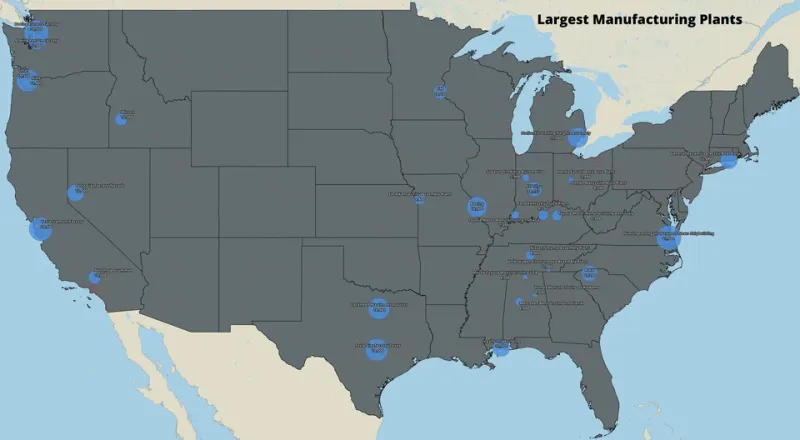
Photo: Wikideas1, CC0, via Wikimedia Commons
For decades, the calculus of offshore manufacturing seemed unassailable. Lower labor costs in Asia and Latin America allowed US companies to compress unit economics in ways that domestic production could not realistically challenge. Yet that calculus is changing — and not merely because of tariff policy or geopolitical friction. A structural shift in how manufacturers think about production geography is underway, and distributed micro-factory networks sit at the center of it.
The question for industrial enterprises is no longer simply "where is labor cheapest?" It has become something considerably more nuanced: where can production be positioned to minimize total landed cost, accelerate market responsiveness, and absorb supply chain shocks without catastrophic disruption? Increasingly, the answer points toward localized, modular manufacturing capacity deployed across domestic or near-domestic regions.
The Total Cost Illusion of Low-Cost Country Sourcing
The sticker price of offshore production has always obscured a longer ledger. When US manufacturers conduct honest total landed cost analyses — accounting for ocean freight, port delays, customs duties, inventory carrying costs, quality-control remediation, and the working capital tied up in extended lead times — the gap between overseas and domestic production narrows considerably.
Recent data reinforces this point. According to analysis published by the Reshoring Initiative, the average total cost premium of US manufacturing over Chinese production has compressed from roughly 40 percent a decade ago to somewhere between 10 and 20 percent in many product categories today. For high-mix, lower-volume manufacturing — the domain where micro-factories excel — the gap frequently disappears entirely once responsiveness and inventory efficiency are factored in.
Micro-factory networks add another dimension to this equation. Because they operate at smaller footprints with lower fixed-cost structures, they can be positioned strategically near customer clusters without requiring the massive capital outlays that traditional domestic facilities demand. The result is a production model that competes not just on cost but on proximity.
Speed-to-Market as a Competitive Asset
In industries where product cycles are compressing and customer expectations for rapid fulfillment are rising, lead time is no longer a secondary consideration — it is a primary source of competitive differentiation.
Consider the automotive components sector. Tier 1 and Tier 2 suppliers serving US assembly plants have historically tolerated 8-to-12-week lead times from Asian contract manufacturers for non-critical parts. As just-in-time inventory discipline has tightened and model changeover cycles have accelerated, that tolerance has eroded. Several mid-sized suppliers have responded by establishing regional micro-factory nodes capable of producing precision stampings, brackets, and specialty fasteners within days rather than weeks.
The speed advantage compounds across the supply chain. When a production run can be adjusted, reprinted, or retooled within 48 hours rather than requiring a transatlantic email chain and a new purchase order to an overseas factory, manufacturers gain the ability to respond to demand signals in near real time. That responsiveness translates directly into reduced finished-goods inventory, fewer markdowns, and stronger customer relationships.
The medical device industry presents a parallel case. FDA regulatory requirements already create strong incentives for domestic production, but micro-factory economics have made compliance-friendly local manufacturing genuinely cost-competitive. Smaller producers of surgical instruments and diagnostic components have found that distributed domestic nodes allow them to serve hospital systems and group purchasing organizations with the delivery speed and lot-size flexibility that overseas production structurally cannot provide.
Supply Chain Resilience as a Measurable Metric
The disruptions of 2020 through 2022 forced a generation of supply chain professionals to confront a metric they had long underweighted: concentration risk. When a single overseas supplier or a single port became unavailable, the downstream consequences were severe and, in many cases, existential for smaller manufacturers.
Distributed micro-factory networks address concentration risk by design. Rather than routing all production through a single facility or geography, they spread capacity across multiple nodes. If one location faces a labor disruption, a natural disaster, or a regulatory complication, adjacent nodes can absorb the load without a complete production stoppage.
This architectural redundancy has a calculable value. Insurance actuaries and supply chain risk consultants increasingly model the cost of disruption events against the premium required to maintain distributed capacity. In sectors such as defense subcontracting, aerospace components, and critical infrastructure hardware, the risk-adjusted case for domestic micro-factory networks is compelling even before traditional cost comparisons are applied.
Where the Model Works Best
Distributed micro-factory production is not a universal solution. High-volume, commodity manufacturing with stable demand profiles and minimal customization requirements may still favor centralized overseas production in some cost environments. The model demonstrates its clearest advantages in specific contexts.
High-mix, low-to-medium volume production is perhaps the most natural fit. When a manufacturer produces dozens of variants rather than a single SKU, the tooling changeover costs and minimum order quantity constraints of overseas production create friction that micro-factories eliminate. Electronics enclosures, precision machined assemblies, and specialty textiles all exhibit this profile.
Geographically sensitive distribution is another strong use case. Consumer goods companies serving regional retail networks have discovered that micro-factory nodes positioned in the Midwest, Southeast, and Mountain West can achieve two-day ground delivery to the majority of their customer base — a logistical advantage that no overseas producer can replicate regardless of unit cost.
Finally, products requiring frequent engineering iteration benefit from the proximity that domestic micro-factories provide. When the design team and the production floor are separated by an ocean, the feedback loop between engineering change orders and manufactured output stretches to weeks. When they share a time zone — or a building — that loop compresses to hours.
The Strategic Reframe
The conversation about reshoring and nearshoring has too often been framed as a patriotic or political argument rather than an economic one. The evidence from distributed micro-factory deployments suggests that the economic argument is, in many sectors, now sufficient on its own terms.
US industrial enterprises that have moved beyond the headline unit-cost comparison and conducted rigorous total-value analyses are finding that localized, distributed production networks offer a combination of cost competitiveness, operational agility, and risk management that the offshore model cannot fully replicate. That finding is reshaping capital allocation decisions across sectors — and the momentum is unlikely to reverse.